Thursday, August 31, 2023

Postdoctoral Fellow in Genetic Toxicology at NIEHS

A postdoctoral position is available in the Systems Toxicology Branch in the Division of the National Toxicology Program (DTT) at the National Institute of Environmental Health Sciences (NIEHS), Research Triangle Park, North Carolina. Please note that the position is in an office-based scientific environment. This position is for a discipline-specific fellowship in the field of genetic toxicology that will be applicable to careers in regulatory science and industrial toxicology. The fellow will gain understanding of key genetic toxicity testing approaches that have Organization for Economic Cooperation and Development (OECD) test guidelines as well as genetic toxicity testing batteries. The fellow will also gain experience with genetic toxicity assays that provide information on the mode-of-action or mechanism-of-action of genotoxicants, such as error-corrected next generation sequencing and multiplexed biomarker assays.

The genetic toxicity testing program at the DTT offers a wide range of opportunities for fellow involvement. A suite of activities with defined products (manuscripts, contributions to DTT Technical Reports and Toxicity Reports, reviews, etc.) can be tailored based on the fellow’s interests, skills, and career goals. Furthermore, the fellow will participate in the design and interpretation of appropriate in vivo and in vitro genetic toxicology studies, which are aligned to DTT strategic scientific priorities and primarily conducted at an external contract research organization (CRO). Emphasis will be placed on understanding the study workflow from design through execution to analysis and reporting.The fellow will have extensive interaction with divisional staff in scientific disciplines such as chemistry, pathology, genetic toxicology, toxicokinetics, toxicogenomics, informatics, statistics, and molecular biology. The curriculum will also include a number of specific experiences (such as CRO site visits and interaction with external stakeholders in the regulatory sciences at other government agencies) that fellows are expected to undertake during their tenure as well as specifically tailored experiences based on the fellow’s identified career interest, if applicable.

The successful applicant will have formal training or experience in one or more areas of: toxicology, genetic toxicology, cellular and molecular biology, biotechnology, DNA replication, DNA damage response, DNA repair, mechanisms of genome maintenance, mutagenesis, carcinogenesis, genomic techniques (e.g., DNA sequencing) and related bioinformatics analyses, in silico methods for prediction of genotoxicity, methods of in vivo to in vitro extrapolation (IVIVE). The successful applicant will also have excellent writing and oral communication skills and will demonstrate a clear interest in working in a highly matrixed, team science environment....

Eligibility: To be eligible for a postdoctoral training fellowship at the DTT, applicants may not possess more than five years of postdoctoral experience and must hold a Ph.D. or equivalent in toxicology or an allied science (e.g., cellular and molecular biology, biochemistry, genomics, bioinformatics, biotechnology, or closely related discipline), M.D., D.V.M., or other equivalent professional degree. All applicants receive consideration without regard to race, religion, color, national origin, gender, sex, sexual orientation, physical or mental disability, political affiliation, age (with statutory exceptions), or any other non-merit factor.

How to Apply: Applications should be submitted by the closing date (see below) and include:

• Curriculum vitae.

• A one-page cover letter in which the applicant describes their background, how their doctoral training has prepared them for a fellowship, and what they hope to achieve if accepted into the program.

• Names and contact information for three references.

Applications should be submitted at: Please submit your application to Dr. Stephanie Smith-Roe via email by October 6, 2023. stephanie.smith-roe@nih.gov

Friday, August 25, 2023

Professor Jay Gan Receives Grant to Provide a More Sustainable Water and Food Supply

Jay Gan, Professor in the Department of Environmental Sciences and an ETOX faculty member, has recently received a major grant from the National Institute of Food and Agriculture to develop new approaches leading to a more sustainable use of water supplies and to reduce the use of harmful chemicals in food.  More information on the grant and Dr. Gan's research can be found in an Inside UCR article.  Our congratulations to Jay for this recognition of his research and ideas. 

Friday, August 18, 2023

Professor Changcheng Zhou Receives a Prestigious RIVER Award from the NIEHS

Professor Changcheng Zhou, faculty member of the Biomedical Sciences Division and ETOX faculty member, was one of only five scientists selected this year by the NIEHS to receive a Revolutionizing Innovative, Visionary Environmental Health Research, or RIVER, award.  This prestigous award provides 8 years of funding to established researchers and supports groundbreaking projects in environmental health sciences.  With the award, Changcheng and his laboratory will investigate how interactions between genes and endocrine disrupting chemicals may increase cardiovascular disease risk. More information about the award can be found on the UCR News website as well as on the NIEHS website.  Our congratulations to Changcheng and his research group for this impressive award and recognition.  I might mention that UCR (and the ETOX Program) now has two RIVER awardees on campus as Professor Yinsheng Wang also received one several years ago. [Photo is from the UCR News article.]

Sunday, August 13, 2023

New Protein Involved in Mitochrondrial DNA Repair Identified

New research by Linlin Zhao and Chia-En Chang, professors of Chemistry and ETOX faculty members, and their graduate students on the Mitochondrial Transcription Factor A (TFAM) has shown that, in addition to helping package DNA in the mitochondria, this protein is also involved in the repair of damaged DNA bases. Their work was recently published in the journal ACS Chemical Biology and highlighted in UCR News.  Our congratulations to Linlin, Chia-En and their students for this recognition of their work.  [The image above is from the UCR News article.]

Saturday, July 29, 2023

Research Shows High Intake of Soybean Oil Induces Colitis in Mice


Recent research by Prof. Frances Sladek, an ETOX faculty member, Prof. James Borneman, Research Scientist Poonam Deol (shown above in photo from UC Riverside News) and colleagues has shown that the consumption of elevated levels of soybean oil by mice alters the bacterial microflora in the gut and resulted in a high incidence of colitis - a form of inflammatory bowel disease, or IBD, characterized by chronic inflammation of the large intestine.  Their studies indicate that olive oil, which has lower amounts of linoleic acid, is a healthier oil to consume. Their work was published in the journal Gut Microbes.  A news release with more detail can be found at UC Riverside News.  

More recently, their work has also been featured on an ABC7 Eyewitness News segment in the Southern California area.  Our congratulations to Frances, Poonam and James for the recognition of their research.  

Wednesday, July 26, 2023

Discovery Leading to Potential Degradation of Select PFAS Chemicals by Professors Men and Liu is Highlighted

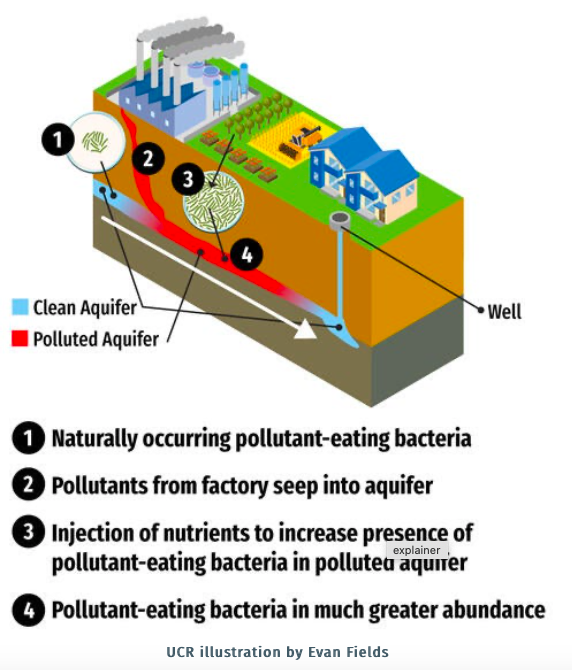
Professors Yujie Men, Jinyong Liu, ETOX faculty members, graduate student Bosen Jin and colleagues have discovered two strains of bacteria which are capable of degrading chlorinated forms of per- and poly-fluoroalkyl substances (PFAS).  PFAS are so resistant to degradation that they are called forever chemicals.  The newly identified bacteria offer hope that a low cost approach can be found to degrade the PFAS class of chemicals. Their work has recently been published in the journal Nature Water.  Their work has resulted in a UCR News article and a brief mention in the Christian Science Monitor.  Our congratulations to Bosen, Yujie, Jinyong for the recognitions of their work.  [The above illustration is from the UCR News article.]

Toxicologist/Biologist Positions, Including Ones for Recent Graduates

The EPA Office overseeing the Toxic Substances Control Act has openings for toxicologists and other environmental scientists.  One set of these positions are focused specifically on recent graduates.  Below are two screen shots with information on the various positions.  Hopefully the QR codes will work when scanned with your smartphone.  Here is a link to USAJobs posting shown in the first screenshot below.  Our thanks to alumna Sharada Balakrishnan for letting us know about the positions.